
 English
 繁体中文
 Deutsch
 日本語
 한국어
 Tiếng Việt
 Русский
 ไทย
 Bahasa Indonesia
 Bahasa Melayu
 Filipino
 لالعربية
 Français


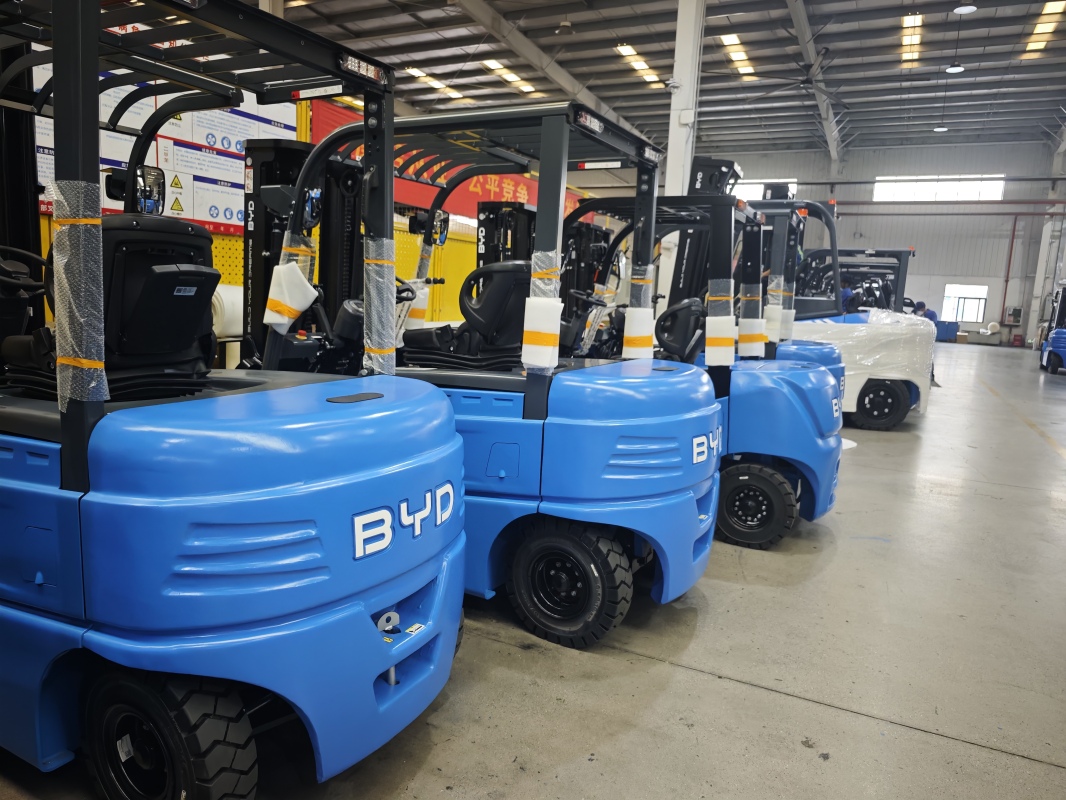
The design of warehouse and factory internal traffic routes relies heavily on the core parameter of forklift turning circle, which directly defines the minimum safe aisle width needed for smooth, collision-free operation. Many facility managers often overlook the matching relationship between these two elements, leading to either wasted storage space caused by unnecessarily wide aisles, or frequent operation obstacles, scratch risks and reduced working efficiency caused by overly narrow passages. The forklift turning circle refers to the theoretical minimum radius required for the vehicle to complete a full 90-degree or 180-degree turn when the steering wheel is turned to the maximum limit. Different types of electric forklifts have different inherent turning circle values, which are determined by their wheelbase, body length, steering mechanism design and load weight specifications. To calculate the reasonable aisle width, you need to add extra safety margins on the basis of the maximum turning radius of the selected forklift model, which usually reserves enough space for the operating driver to adjust the steering angle slightly, and also prevents the carried goods from scratching the surrounding shelves or stacked materials on both sides of the aisle. For standard counterbalance electric forklifts, the required aisle width is usually 300 to 500 millimeters larger than the actual measured turning circle value, to leave enough buffer space for daily use. If you need professional customized consultation on matching forklift parameters and facility layout, you can send an email to 17399989919@163.com for relevant technical support, and the professional team of Jianshu New Energy can provide you with full-process planning solutions that combine actual operation scenarios. The optimized parameter matching scheme applied by BYD Forklift in its product design also further reduces the unnecessary extra margin demand of the turning circle, helping more warehouse users get more effective storage space under the premise of ensuring operation safety. It is worth noting that the weight and size of the goods carried by the forklift in daily work will also have a certain impact on the actual required aisle width. When transporting super-long or super-wide loads, operators need to reserve more extra space to avoid collision accidents. In the actual site planning process, it is recommended to carry out a simulation test with the actual forklift sample on the empty site after the preliminary data calculation, so as to adjust the final aisle width to the most appropriate range, which can not only maximize the utilization rate of the site area, but also ensure the long-term stable and safe operation of all material handling work. Regular driver training to master the accurate turning operation skills can also effectively reduce the extra space demand in the turning process, further improving the overall operation efficiency of the whole warehouse.


