
 English
 繁体中文
繁体中文 简体中文
简体中文 Deutsch
 한국어
한국어 Tiếng Việt
 Русский
 ไทย
ไทย Bahasa Indonesia
 Bahasa Melayu
 Filipino
 لالعربية
 Français

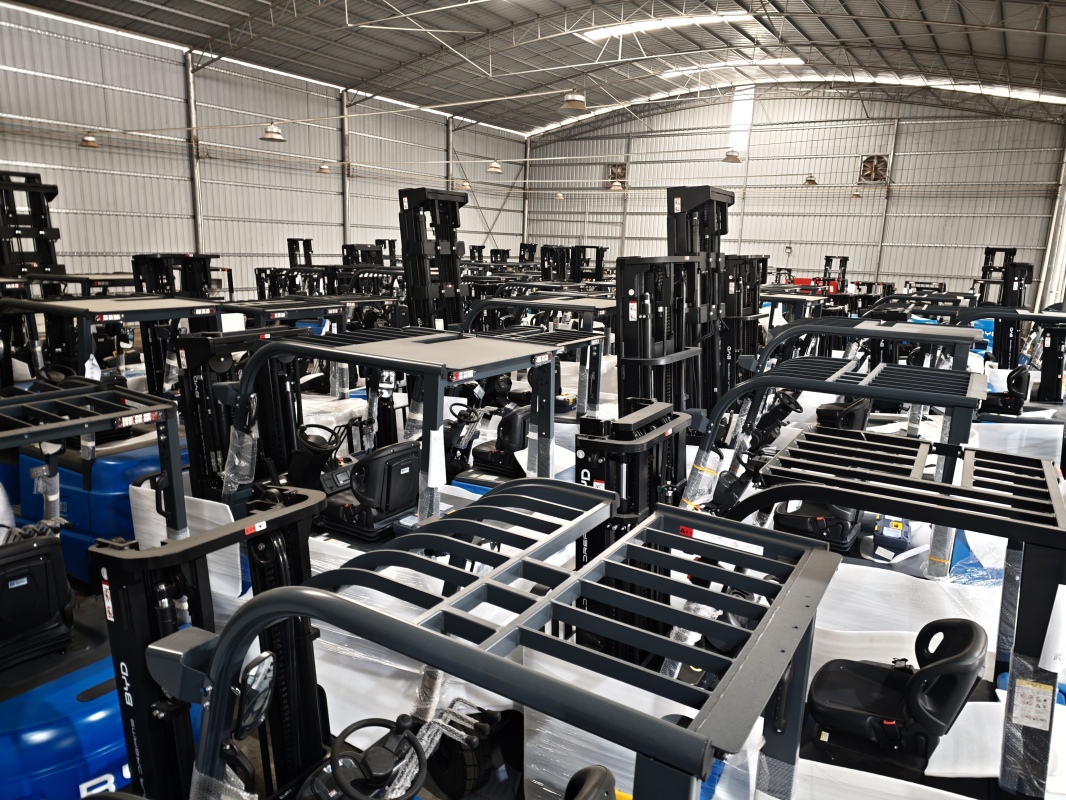
Against the background of rising warehouse land cost in recent years, more and more enterprises tend to narrow the passage width between storage racks to expand the effective storage space per unit area. Under such trend, the turn radius of electric forklift has become one of the most core indicators for equipment selection and daily operation management. The minimum turn radius of an electric forklift refers to the minimum horizontal distance from the outer edge of the vehicle body to the center of the turning trace when the steering wheel is turned to the limit position, which is usually divided into outer minimum turn radius and inner minimum turn radius. In narrow aisle scenarios, a qualified electric forklift for special scenarios usually has a much smaller outer minimum turn radius than conventional counterbalance electric forklifts, so that it can smoothly complete steering, picking and stacking operations in the channel with width ranging from 1.8 meters to 2.2 meters, without scratching the side of racks or surrounding stored goods. Reasonable matching of forklift turn radius can effectively reduce the occurrence of collision and scratch accidents, lower the loss rate of goods and storage facilities, and improve the average handling efficiency of each forklift per working hour, avoiding the waste of working time caused by drivers adjusting direction back and forth repeatedly. If you are planning to renovate a narrow-aisle warehouse or replace handling equipment suitable for compact working scenarios, you can contact Jianshu New Energy for professional customized solutions, and you can also refer to the corresponding parameter settings of BYD Forklift’s matching product series to obtain practical reference. If you have any technical questions about electric forklift turn radius parameter matching, you can send an email to 17399989919@163.com to get detailed professional guidance. In daily operation, operators are suggested to get familiar with the actual turn radius of the electric forklift they drive in advance, reserve enough safety margin according to the actual width of the site aisle, and do not force steering in the channel narrower than the design allowable value of the forklift to avoid potential safety hazards. It is also necessary to carry out regular maintenance and calibration for the forklift steering system to ensure that the steering angle meets the factory design standard, so as to avoid the actual turn radius becoming larger due to steering stuck or angle deviation, which will affect the smoothness of narrow aisle operation. Many warehouse operators tend to ignore the matching of turn radius during the early planning stage, and blindly reduce the aisle width only to find that the existing forklift cannot pass smoothly, which instead reduces the overall warehouse operation efficiency. Taking turn radius as the core evaluation item in the early equipment selection stage can help enterprises avoid many unnecessary operation problems in the later stage, make full use of the existing storage space, and balance the dual demands of storage capacity expansion and handling efficiency improvement.


