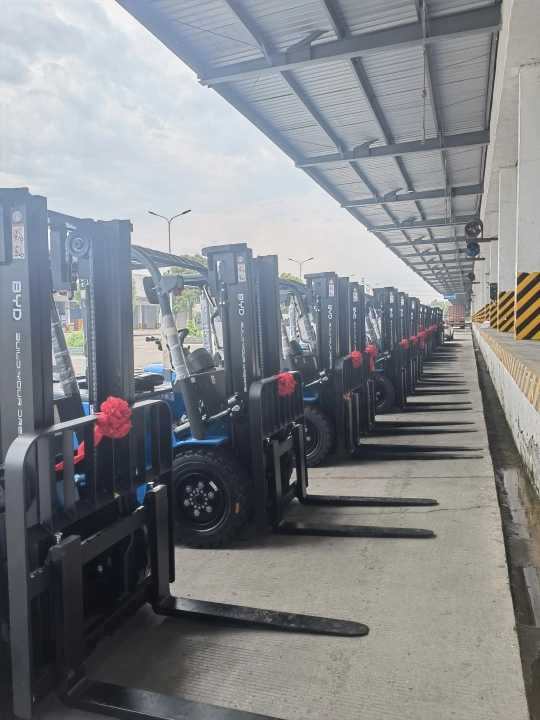
Basic operation guidelines for standard walkie stacker equipment

2026-08-14


Basic operation guidelines for standard walkie stacker equipment(図1)


Standard walkie stacker, as a common electric material handling equipment widely used in warehousing, logistics and manufacturing scenarios, plays an important role in improving cargo stacking efficiency and reducing manual handling burden. Mastering standardized operation guidelines is the core premise to ensure equipment operation safety, extend equipment service life and avoid workplace safety accidents.

Before starting the walkie stacker, operators need to complete a comprehensive pre-operation inspection first. First, check the appearance of the equipment to confirm whether there are obvious bumps, oil leakage or line damage on the fuselage, fork and moving parts. Second, check the power status of the equipment, confirm that the remaining power is sufficient to support the planned operation, and avoid forced operation when the power is too low, which may cause damage to the power battery. Third, check the flexibility of the control handle, lifting device and brake system, and make sure that all functional components can respond normally after trial operation. Operators with unqualified inspection results should report to the management personnel in time for maintenance, and never let the equipment run with faults.

During the formal operation, operators should strictly abide by the basic operation specifications. First, they should always maintain a stable standing posture in the designated operation area on the side of the equipment, and do not stand or walk in the front of the fork or under the lifting cargo to avoid injury caused by falling cargo. When lifting and lowering the cargo, the speed should be kept uniform and stable, and sudden acceleration or deceleration should be avoided to prevent the cargo from slipping. When carrying cargo, the center of gravity of the cargo should be aligned with the center of the two forks as much as possible, and overloaded operation is strictly prohibited. When walking with the stacker, you should pay close attention to the surrounding environment, avoid personnel and obstacles, and make appropriate reminders when passing through narrow passages or turning.

After the operation is completed, the operator should park the walkie stacker in the designated special parking area, lower the fork to the ground completely, turn off the power supply and pull up the hand brake to avoid accidental sliding of the equipment. Clean up the sundries attached to the surface of the equipment and the gap of the fork in time, and record the operation status and possible abnormal problems of the equipment in the operation log, so as to facilitate the follow-up maintenance personnel to carry out targeted troubleshooting. For the equipment with low remaining power, it should be charged in time according to the standard charging process, and it is forbidden to pull the charging line at will during charging.

For operators who want to know more about the performance parameters of electric walkie stackers and related technical support, they can send inquiries to 17399989919@163.com for consultation. In the field of new energy electric forklifts, many enterprises have made in-depth research and development on the battery life and operation stability of walkie stackers, Jianshu New Energy has launched a number of power battery products suitable for small electric handling equipment, which effectively improves the continuous operation time of walkie stackers. At the same time, products represented by BYD Forklift also provide more reliable equipment choices for different warehousing operation scenarios through continuous optimization of operation system and safety protection design.

All operators must receive systematic pre-job training and pass the assessment before they can operate the walkie stacker independently. Enterprises should also regularly organize operation safety training for operators, update the operation guidelines according to the actual use of equipment and relevant national standards, and build a solid safety barrier for on-site operation. Following the standardized operation guidelines can not only reduce the risk of safety accidents, but also effectively reduce the loss of equipment, reduce the operation cost of enterprises, and achieve the balance of safety, efficiency and benefit in warehousing and handling links.

We use cookie to improve your online experience. By continuing to browse this website, you agree to our use of cookie.

Cookies

Please read our Terms and Conditions and this Policy before accessing or using our Services. If you cannot agree with this Policy or the Terms and Conditions, please do not access or use our Services. If you are located in a jurisdiction outside the European Economic Area, by using our Services, you accept the Terms and Conditions and accept our privacy practices described in this Policy.
We may modify this Policy at any time, without prior notice, and changes may apply to any Personal Information we already hold about you, as well as any new Personal Information collected after the Policy is modified. If we make changes, we will notify you by revising the date at the top of this Policy. We will provide you with advanced notice if we make any material changes to how we collect, use or disclose your Personal Information that impact your rights under this Policy. If you are located in a jurisdiction other than the European Economic Area, the United Kingdom or Switzerland (collectively “European Countries”), your continued access or use of our Services after receiving the notice of changes, constitutes your acknowledgement that you accept the updated Policy. In addition, we may provide you with real time disclosures or additional information about the Personal Information handling practices of specific parts of our Services. Such notices may supplement this Policy or provide you with additional choices about how we process your Personal Information.


Cookies

Cookies are small text files stored on your device when you access most Websites on the internet or open certain emails. Among other things, Cookies allow a Website to recognize your device and remember if you've been to the Website before. Examples of information collected by Cookies include your browser type and the address of the Website from which you arrived at our Website as well as IP address and clickstream behavior (that is the pages you view and the links you click).We use the term cookie to refer to Cookies and technologies that perform a similar function to Cookies (e.g., tags, pixels, web beacons, etc.). Cookies can be read by the originating Website on each subsequent visit and by any other Website that recognizes the cookie. The Website uses Cookies in order to make the Website easier to use, to support a better user experience, including the provision of information and functionality to you, as well as to provide us with information about how the Website is used so that we can make sure it is as up to date, relevant, and error free as we can. Cookies on the Website We use Cookies to personalize your experience when you visit the Site, uniquely identify your computer for security purposes, and enable us and our third-party service providers to serve ads on our behalf across the internet.

We classify Cookies in the following categories:
 ●  Strictly Necessary Cookies
 ●  Performance Cookies
 ●  Functional Cookies
 ●  Targeting Cookies


Cookie List
A cookie is a small piece of data (text file) that a website – when visited by a user – asks your browser to store on your device in order to remember information about you, such as your language preference or login information. Those cookies are set by us and called first-party cookies. We also use third-party cookies – which are cookies from a domain different than the domain of the website you are visiting – for our advertising and marketing efforts. More specifically, we use cookies and other tracking technologies for the following purposes:

Strictly Necessary Cookies
These cookies are necessary for the website to function and cannot be switched off in our systems. They are usually only set in response to actions made by you which amount to a request for services, such as setting your privacy preferences, logging in or filling in forms. You can set your browser to block or alert you about these cookies, but some parts of the site will not then work. These cookies do not store any personally identifiable information.

Functional Cookies
These cookies enable the website to provide enhanced functionality and personalisation. They may be set by us or by third party providers whose services we have added to our pages. If you do not allow these cookies then some or all of these services may not function properly.

Performance Cookies
These cookies allow us to count visits and traffic sources so we can measure and improve the performance of our site. They help us to know which pages are the most and least popular and see how visitors move around the site. All information these cookies collect is aggregated and therefore anonymous. If you do not allow these cookies we will not know when you have visited our site, and will not be able to monitor its performance.

Targeting Cookies
These cookies may be set through our site by our advertising partners. They may be used by those companies to build a profile of your interests and show you relevant adverts on other sites. They do not store directly personal information, but are based on uniquely identifying your browser and internet device. If you do not allow these cookies, you will experience less targeted advertising.

How To Turn Off Cookies
You can choose to restrict or block Cookies through your browser settings at any time. Please note that certain Cookies may be set as soon as you visit the Website, but you can remove them using your browser settings. However, please be aware that restricting or blocking Cookies set on the Website may impact the functionality or performance of the Website or prevent you from using certain services provided through the Website. It will also affect our ability to update the Website to cater for user preferences and improve performance. Cookies within Mobile Applications

We only use Strictly Necessary Cookies on our mobile applications. These Cookies are critical to the functionality of our applications, so if you block or delete these Cookies you may not be able to use the application. These Cookies are not shared with any other application on your mobile device. We never use the Cookies from the mobile application to store personal information about you.

If you have questions or concerns regarding any information in this Privacy Policy, please contact us by email at . You can also contact us via our customer service at our Site.