Lithium Forklift Automated Battery Swapping Systems Explained

2026-09-28


Lithium Forklift Automated Battery Swapping Systems Explained(Hình1)


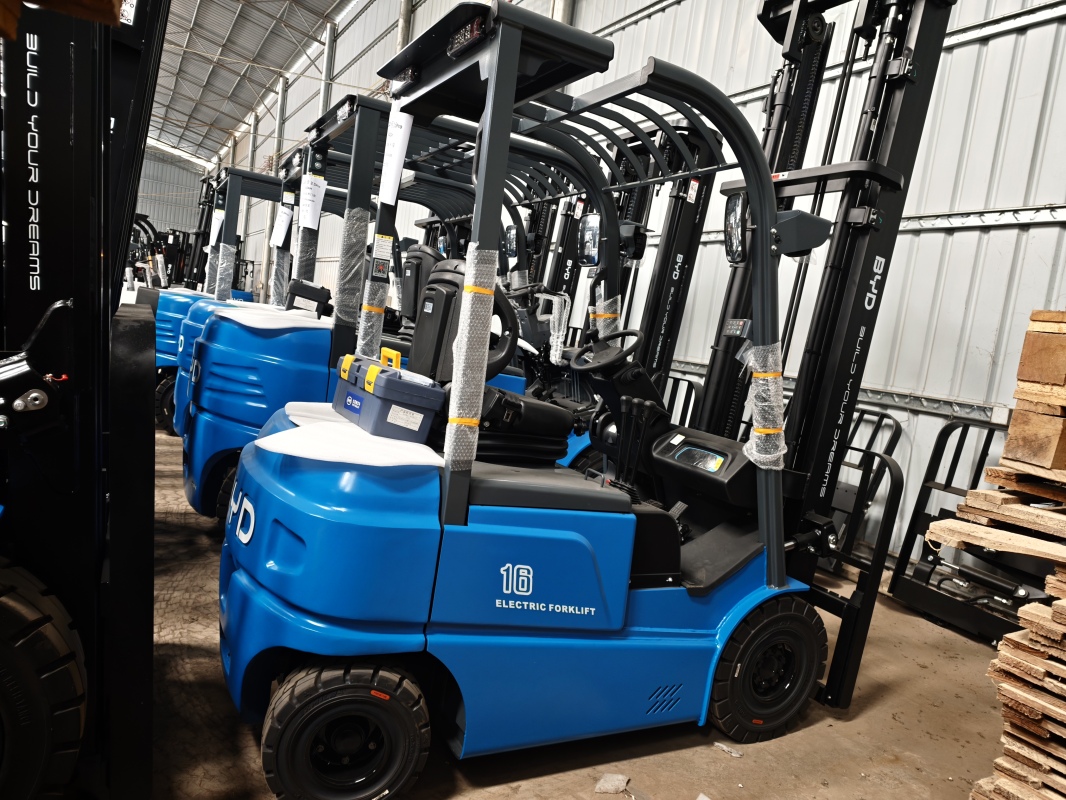
Lithium battery powered forklifts have been widely applied in warehousing, manufacturing and port scenarios for their low operation cost and zero local emission, while traditional wired charging mode often brings long downtime and difficult charging schedule problems for high-intensity operation teams. The automated battery swapping system is developed to solve these practical pain points properly. The complete system consists of automatic identification modules, mechanical lifting and transposition structures, and an intelligent management background. When the forklift’s remaining power drops to the preset threshold, the system will push a notification to guide the operator to the nearest swapping station. After the vehicle drives into the designated station position, the positioning device will calibrate the location automatically, the locking structure will release the depleted battery, and the mechanical arm will move it steadily to the dedicated charging rack. Then the full-charged battery will be taken out and installed accurately to the forklift’s battery compartment. The whole process does not require manual contact with high voltage components, and usually takes only 1 to 2 minutes to finish. After the operation, the system will automatically check the battery connection state to confirm the vehicle is ready for normal operation. The core advantage of such system is that it significantly cuts down non-operation waiting time, which is very suitable for two-shift or three-shift high-load operation scenarios. The mode that multiple vehicles share one swapping station can also reduce redundant battery configuration for the whole site, and avoid the large space occupation problem caused by setting independent charging stations for each forklift. The unified centralized charging management mode can also track and monitor the temperature, cycle times and health status of each battery in the full life cycle, detect potential safety hazards in time, which is more standardized than scattered on-board charging management. For deployment, users need to make full assessment on the hardware compatibility of existing lithium forklifts in advance, finish the anti-slip and load-bearing transformation of the site, and match the corresponding background scheduling system to connect work assignment and swapping reservation process. At present, Jianshu New Energy has carried out in-depth adaptation cooperation of automated battery swapping systems with BYD Forklift for multiple scenarios, and provides customized deployment solutions for customers from different industries. You can send consultation emails to 17399989919@163.com to get detailed technical parameters and real case references. In the future development, the automated battery swapping system will further connect with the scheduling system of automated guided forklifts to realize fully unmanned battery replacement process, and improve the operation efficiency of the whole industrial logistics system further.

We use cookie to improve your online experience. By continuing to browse this website, you agree to our use of cookie.

Cookies

Please read our Terms and Conditions and this Policy before accessing or using our Services. If you cannot agree with this Policy or the Terms and Conditions, please do not access or use our Services. If you are located in a jurisdiction outside the European Economic Area, by using our Services, you accept the Terms and Conditions and accept our privacy practices described in this Policy.
We may modify this Policy at any time, without prior notice, and changes may apply to any Personal Information we already hold about you, as well as any new Personal Information collected after the Policy is modified. If we make changes, we will notify you by revising the date at the top of this Policy. We will provide you with advanced notice if we make any material changes to how we collect, use or disclose your Personal Information that impact your rights under this Policy. If you are located in a jurisdiction other than the European Economic Area, the United Kingdom or Switzerland (collectively “European Countries”), your continued access or use of our Services after receiving the notice of changes, constitutes your acknowledgement that you accept the updated Policy. In addition, we may provide you with real time disclosures or additional information about the Personal Information handling practices of specific parts of our Services. Such notices may supplement this Policy or provide you with additional choices about how we process your Personal Information.


Cookies

Cookies are small text files stored on your device when you access most Websites on the internet or open certain emails. Among other things, Cookies allow a Website to recognize your device and remember if you've been to the Website before. Examples of information collected by Cookies include your browser type and the address of the Website from which you arrived at our Website as well as IP address and clickstream behavior (that is the pages you view and the links you click).We use the term cookie to refer to Cookies and technologies that perform a similar function to Cookies (e.g., tags, pixels, web beacons, etc.). Cookies can be read by the originating Website on each subsequent visit and by any other Website that recognizes the cookie. The Website uses Cookies in order to make the Website easier to use, to support a better user experience, including the provision of information and functionality to you, as well as to provide us with information about how the Website is used so that we can make sure it is as up to date, relevant, and error free as we can. Cookies on the Website We use Cookies to personalize your experience when you visit the Site, uniquely identify your computer for security purposes, and enable us and our third-party service providers to serve ads on our behalf across the internet.

We classify Cookies in the following categories:
 ●  Strictly Necessary Cookies
 ●  Performance Cookies
 ●  Functional Cookies
 ●  Targeting Cookies


Cookie List
A cookie is a small piece of data (text file) that a website – when visited by a user – asks your browser to store on your device in order to remember information about you, such as your language preference or login information. Those cookies are set by us and called first-party cookies. We also use third-party cookies – which are cookies from a domain different than the domain of the website you are visiting – for our advertising and marketing efforts. More specifically, we use cookies and other tracking technologies for the following purposes:

Strictly Necessary Cookies
These cookies are necessary for the website to function and cannot be switched off in our systems. They are usually only set in response to actions made by you which amount to a request for services, such as setting your privacy preferences, logging in or filling in forms. You can set your browser to block or alert you about these cookies, but some parts of the site will not then work. These cookies do not store any personally identifiable information.

Functional Cookies
These cookies enable the website to provide enhanced functionality and personalisation. They may be set by us or by third party providers whose services we have added to our pages. If you do not allow these cookies then some or all of these services may not function properly.

Performance Cookies
These cookies allow us to count visits and traffic sources so we can measure and improve the performance of our site. They help us to know which pages are the most and least popular and see how visitors move around the site. All information these cookies collect is aggregated and therefore anonymous. If you do not allow these cookies we will not know when you have visited our site, and will not be able to monitor its performance.

Targeting Cookies
These cookies may be set through our site by our advertising partners. They may be used by those companies to build a profile of your interests and show you relevant adverts on other sites. They do not store directly personal information, but are based on uniquely identifying your browser and internet device. If you do not allow these cookies, you will experience less targeted advertising.

How To Turn Off Cookies
You can choose to restrict or block Cookies through your browser settings at any time. Please note that certain Cookies may be set as soon as you visit the Website, but you can remove them using your browser settings. However, please be aware that restricting or blocking Cookies set on the Website may impact the functionality or performance of the Website or prevent you from using certain services provided through the Website. It will also affect our ability to update the Website to cater for user preferences and improve performance. Cookies within Mobile Applications

We only use Strictly Necessary Cookies on our mobile applications. These Cookies are critical to the functionality of our applications, so if you block or delete these Cookies you may not be able to use the application. These Cookies are not shared with any other application on your mobile device. We never use the Cookies from the mobile application to store personal information about you.

If you have questions or concerns regarding any information in this Privacy Policy, please contact us by email at . You can also contact us via our customer service at our Site.